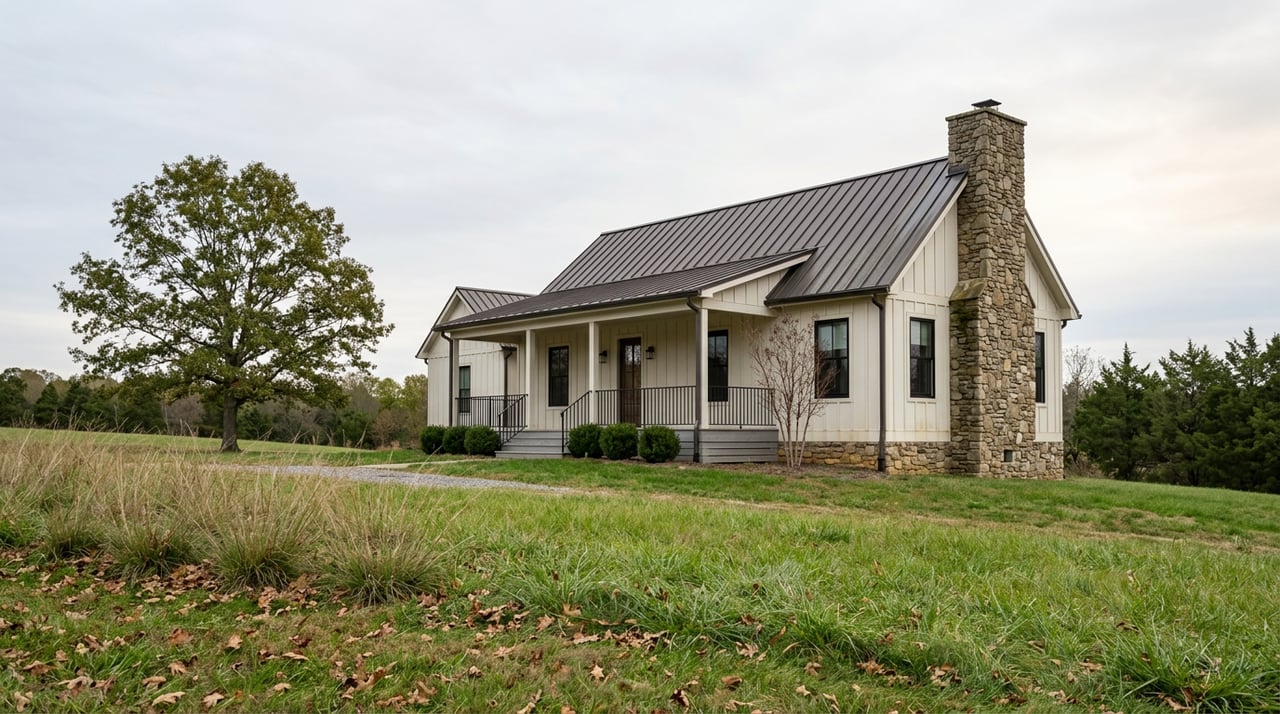
Why The Cheapest Acre In York County Isn't Always The Cheapest Lot To Build On
September 3, 2026
September 3, 2026
Pull up two land search sites and look at York County, Pennsylvania on the same afternoon, as the listings stood in late August 2026. One tells you the average cost to buy land here runs $77,456 per acre. Another, looking at the same county, puts the median at $31,912 per acre. A third version of that same second site, filtered to undeveloped land only, drops to $24,423.
That is not a typo and it is not a stale cache. It is three different populations of land being reported as if they were one number. A buyer comparing listings against these figures is not comparing apples to apples. They are comparing a farm field in Red Lion to a subdivided homesite in a cul-de-sac off Route 30, and the site math treats them as the same commodity.
The real question a land buyer in York County needs answered is not what an acre costs. It is what an acre costs to make buildable, and that number does not live on the listing page at all.
Here is what the spread actually looks like when you set the sources side by side.
| Source and filter | Reported price per acre | What's likely driving the number |
|---|---|---|
| County-wide average, all listings | $77,456 | Includes small, utility-connected homesites priced by the lot, not the acre |
| County-wide median, all land | $31,912 to $44,043 | Mix of raw acreage and homesites, median smooths out extremes |
| Undeveloped land only | $24,423 | Larger, unimproved parcels with no utilities, priced closer to farmland value |
The gap is the story. A small, utility-ready building lot in a platted subdivision prices by the lot rather than the acre, so its per-acre equivalent runs far higher than raw ground ever would. A large parcel of open farmland with no utilities in place prices closer to agricultural land value per acre, because that infrastructure gap is precisely what a buyer is pricing in when they make an offer. Average the two together across a county with plenty of both for sale and you get a number that describes neither property honestly.
If you are shopping for a homesite to build one house, the per-acre price on a small subdivided lot and a large raw parcel are answering different questions. The subdivided lot's price already includes utility access. The raw parcel's price does not, and that gap is where a project's real cost hides.
Pennsylvania handles septic permitting differently than most states, and it is the detail that trips up buyers moving in from Maryland or anywhere with a county health department running the process. There is no statewide septic authority reviewing your site. Every township is required to designate its own Sewage Enforcement Officer, and that local officer, not a county or state agency, controls the entire path from soil test to installed system.
This traces back to a 1966 law, the Pennsylvania Sewage Facilities Act, commonly called Act 537, which requires every municipality to maintain its own Official Sewage Facilities Plan. If a township's plan hasn't been updated recently, that alone can slow down a new construction permit, something rural land buyers in York County tend to discover only after they've made an offer.
Before any permit gets issued, the SEO evaluates the site with soil probes and a percolation test, digging test pits to check soil texture, drainage, and depth to bedrock or the seasonal water table. Pennsylvania's standard calls for a minimum of six soil probe holes at the proposed drainfield location, more thorough than a simple perc test alone. The site evaluation typically costs $300 to $600 and the results determine what kind of system, if any, the lot can support.
Here is the sequence a York County land buyer is actually working against, once an offer is signed:
For a conventional gravity-fed system, the whole sequence from first SEO contact to an approved permit runs roughly 3 to 8 weeks. If the soil fails for a conventional system and the township requires an alternative design, add another 4 to 8 weeks on top of that. That is time layered on top of whatever your builder already needs for financing, plans, and a building permit, and in the city of York proper, initial plan review alone has been running about 15 days as of early 2026.
Anyone who has scrolled land listings in this county has seen the phrase "new well, recently tested septic" attached to a premium, and seen "raw land, no utilities connected" attached to a discount. The pattern is not random. York County's soil, like much of the surrounding Appalachian terrain, often runs shallow to bedrock or heavy in clay, conditions that frequently rule out a conventional drainfield. When that happens, the fallback is a sand mound system, an engineered above-grade design that is common enough here to be treated as ordinary rather than exceptional.
A sand mound costs more to design and install than a conventional system and takes longer to permit, which is exactly the extra 4 to 8 weeks referenced above. It also changes where a house can sit on the lot, since the mound itself occupies a defined footprint with its own setback requirements. Pennsylvania mandates at least 100 feet between a septic system and any private well, a rule that becomes the actual constraint on house placement for a rural lot that needs both.
This is the piece that never shows up in a per-acre price. Two parcels can be priced identically and only one of them can support a house without a five-figure sand mound and a multi-month wait.
Walking a few current York County listings shows the difference between a price and a plan.
In Stewartstown, a parcel at the end of Mill Street is being marketed specifically for its flat, buildable terrain, a detail sellers highlight because it signals an easier path through soil testing, not just easier construction. In Glenville, a 1.47-acre lot is listed as a blank canvas, the kind of raw parcel where the per-acre price looks attractive until you price in a well and a system from scratch. On Fairview Drive in Hanover, a 1.09-acre lot is marketed with a new well and a recently tested septic system already in place, and that single line item is doing more to justify its price than the acreage figure next to it.
Further out, a 23-acre homesite near Dillsburg is being marketed around its gently rolling, mostly open acreage and its commuter access to Harrisburg, Mechanicsburg, and York, the kind of pitch aimed at a buyer weighing a single estate lot against a small subdivision. Rolling terrain like that still has to clear a soil probe before either plan moves forward. And at Harambe Overlook, lots near the Southern School District and the Maryland line are being marketed with a named builder already attached, Custom Home Group, a York and Lancaster area builder. That pairing matters because a lot sold alongside a builder relationship has usually already cleared some of the site-evaluation uncertainty that trips up buy-then-build-later purchases.
None of these are guesses about what land in York County costs. They are current examples of the same lesson: the acreage number on the listing tells you almost nothing about the timeline or the total cost of getting a foundation poured. The soil test does.
Does a passed perc test transfer if I buy the land from someone who already tested it? Generally yes, since septic permits run with the property rather than the person, but results have a shelf life and older tests can be considered stale if site conditions have changed. Ask the seller for documentation and check with the township SEO on how recent it needs to be.
What if the township hasn't updated its sewage facilities plan in years? That can genuinely slow a new construction permit down, since the plan required under Act 537 is what the SEO works from. It is worth asking the township directly, before you're under contract, rather than discovering it during due diligence.
Is well-and-septic really still common this close to Hanover or Stewartstown? Yes, plenty of listings just outside those boroughs, including several referenced above, are on private well and septic rather than public utilities, even within easy driving distance of town centers.
If you are weighing a raw parcel against a lot with utilities already stubbed in, the acreage price is the least useful number in the comparison. A soil test result, a builder relationship already in place, and a township with an up to date sewage plan are worth more to your timeline than a lower price per acre ever will be. That is the kind of groundwork Homes with Erin Kelly walks through with land and custom-build buyers before an offer goes in, not after. If you're evaluating a homesite in York County or anywhere across Southern Pennsylvania, take a look at the York neighborhood guide or the buyer's guide for a fuller picture of the process, and reach out when you're ready. Let's Build Your Strategy.
Your home is more than an address—it’s a reflection of your lifestyle. Partner with an expert who truly understands what luxury means.